
Oklahoma City Metro · Accessible Parking
Accessible parking is the one part of your lot where the dimensions are written down. We measure yours, mark it to those dimensions, and hand you the record.
What it actually is
Accessible stalls are not just a blue symbol. The 2010 ADA Standards for Accessible Design set out stall and access-aisle widths, how many accessible spaces a lot needs for its total count, how many of those must be van accessible, where they sit relative to the accessible entrance, and what signage has to be posted and how high. Slope matters too — accessible stalls and their access aisles are held to tight cross-slope limits in all directions.
Most of the non-conforming lots we walk are not neglected. They were striped correctly years ago, then restriped by somebody working off what was already on the ground, and the access aisle lost six inches at a time. Or the lot was expanded and the stall count went up without the accessible count following it.
Worth being precise about the legal picture, because it is often muddled. Oklahoma law (47 O.S. §11-1007) sets a $500 fine for parking in a designated accessible space without authorization — that penalty falls on the driver, not on the property owner and not on the contractor. Property-side exposure under the ADA is a separate, federal matter and is not what that statute covers. What both have in common is that they only work if the spaces are actually laid out, marked and signed the way the standard describes.
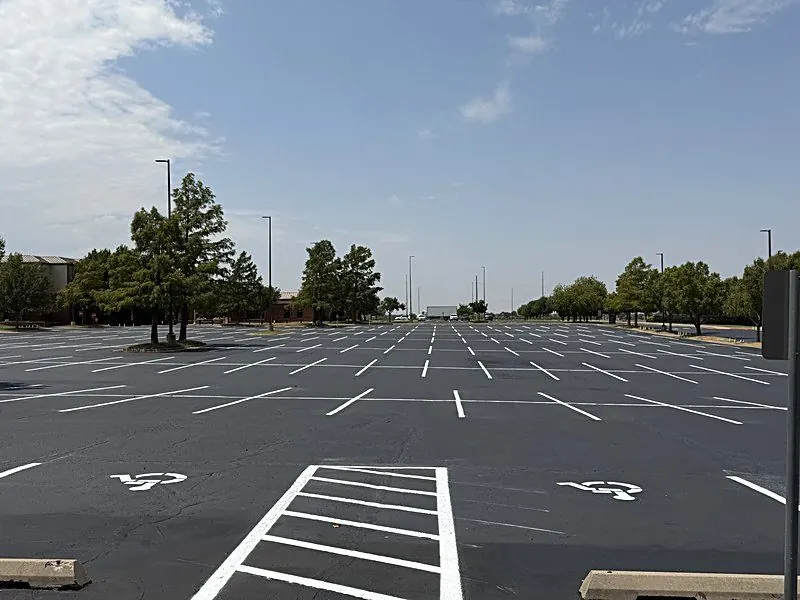
What we do, and what we do not do. We measure your existing accessible parking, mark and sign it to the dimensions set out in the 2010 ADA Standards for Accessible Design, and give you written documentation of what we found and what we changed. We are a pavement contractor. We are not accessibility consultants, licensed inspectors, architects or attorneys, and we do not certify that a property is ADA compliant — no striping contractor can. Compliance is determined by your own counsel, a qualified accessibility professional, and the authority having jurisdiction. Where an issue falls outside what striping can address — running slope or cross slope, curb ramps, the accessible route from the stall to the entrance, or the number of spaces a lot requires — we will document it and tell you it needs a design professional, rather than paint over it and call it done.
Scope
We measure your existing accessible stalls, access aisles, and signage, and count them against the total stall count on the lot.
Photographs and measurements of what we found — including anything we are not able to fix with paint, such as a slope or a route issue.
Accessible stalls, striped access aisles, and van-accessible spaces laid out to the dimensions in the 2010 ADA Standards.
The accessible symbol and any accompanying legend, applied so it reads clearly from the drive aisle.
Signs set at the required mounting height, including van-accessible designation where it applies.
Before-and-after photos and measurements, so you have a record for your file.
Process
We do not price ADA work off a photo. The stall count, the aisle widths, and the route to the entrance all change what the job actually is.
If the issue is cross-slope, a curb ramp, or the accessible route itself, that is concrete or grading work, not striping. You will hear that plainly, with the measurement, rather than getting a restripe that leaves the real problem in place.
We phase so the property is never without accessible parking during business hours — temporary designated spaces while the permanent ones cure.
What we measured, what we changed, and what remains outside the scope of striping.
Who it is for
Commercial properties only. We do not take residential driveway work.
Timing
Striping-based ADA work follows the same dry-surface window as any other marking job. The assessment and measurement can happen any time of year, which makes winter a good moment to find out where you stand before spring scheduling fills up.